October 04, 2020

MWK is likely to be a superstock

I was excited when I discovered Mohawk (MWK) because it checks off most boxes of a potential super stock. It has a huge breakout with large volume back in April 2020, forward P/S ratio less than 1, rapid revenue growth, enormous operating leverage to expand profit margin, founder-operated business with a strong incentive to increase the stock price and a super theme in AI and eCommerce.

The reason why I like MWK:
  • Low market cap $125M with relative low float 15.4M shares 
  • Low forward P/S ratio = 0.64 with rapid revenue growth and profit margin expansion
  • It's at the inflection point - recent quarter is the first quarter that reports positive adjusted EBITDA.
  • Enormous operating leverage with economies of scale: small increase in fixed cost as revenue grows
  • CEO/CFO/CRO have large # of options exercisable at the price of $9.72
  • Recent insider buying on open market
  • eCommerce/AI theme

Company Overview
I cannot do a better job to describe what MWK does than the company itself. This is how it puts it in the most recent investor presentation - Mohawk Group Holdings is a rapidly growing technology-enabled consumer products company. Its proprietary AIMEE (AI Mohawk eCommerce Engine) platform leverages data and AI to automate the design, development, and launch of best-selling consumer products:
  • Identifies new market opportunities
  • Launches new products
  • Automates marketing variables
  • Analyzes and optimizes owned and operated consumer product brands
The company has identified the secular trend of declining value of brand recognition in the context of eCommerce - customers do not begin their product search by searching specific brand names; instead, customers rely on reviews and compare prices to make their purchase decisions. This has given Mohawk ample opportunity to compete with well-established big brands. The graph below contrasts the difference between Mohawk's business model vs the traditional approach. AIMEE platform has significantly improved the life cycle of product launch and shortened the time from idea generation to product fulfillment.


Technical Chart
I like technical charts as a great starting point to screen stocks because charts are the real-time visualization of market psychology. Unlike 10-Q and 10-K forms that look at a company from the rear mirror, charts are always forward looking and tell a lot more about the future.

MWK had a big breakout with its record weekly volume in April 2020 - the market starts to show lots of interest in this stock and the stock has begun its upward trend since the breakout. The price trend follows 11-week moving average pretty closely, which serves as a support level. Every stock has its own main trend line to follow (the implicit line exists because it is also the indicator that big money players look at to decide their buying point). Any price action that deviates too far away from the main trend will eventually be pulled back closer to it. The current position provides a favorable risk/reward profile and a low-risk entry point. The price is right around the main trend line with a tight weekly price range and a light volume. 

Bonus section about chartists
I didn't appreciate charts as much until many trading books I recently read helped me understand how much chart can actually reveal. However, many books have covered a lot about HOW to use charts correctly, but very few of them have explained the theories behind WHY charts are useful. The following section is not related to MWK specifically but more of my own thoughts I want to write down to reconcile what I've learnt lately. Feel free to skip this part if you are here for MWK.

Charts have two main components: volume and price. Trading volume essentially measures the amount of disagreement on the price of a stock. People sell because they think a stock is overpriced while people buy because they think a stock is underpriced. When there is disagreement on the price, there is transaction. When there is a lot of disagreement, there will be a lot of transaction and hence a large trading volume. In contrast, when the market has lots of consensus on what the price should be (think bond market), fewer people transact and the market reaches equilibrium, which is always accompanied with a lower trading volume.

On the other hand, stock prices are always determined by the most optimistic buyers who are willing to pay the highest on the market - a stock, therefore, is more likely to be overpriced when the trading volume is high and when the crowd is enthusiastic. When I say overpriced here, it's only short-term price action - it means buying at a high volume is likely to experience higher volatility and correction/consolidation after the market calms down.

Theoretically, if the stock has strong fundamentals, given long enough holding period, buying at high volume is not a problem because any price correction will eventually come back up in long run to catch up with its fundamentals. However, practically, this price correction always goes against human nature and is proven to be a problem for many people who failed to make the biggest profits from stock market. Many people lose money in stock market not because they didn't find the right stocks to buy; most of the time, they failed because they didn't hold the stock long enough until they make money.

Although the correction for stocks with strong fundamentals is believed to be temporary, nobody can really predict how much the correction will be - it can be as little as 5% or as much as 30%, easily. The most common reason to sell too early is the emotional pain one has to endure with extended period of paper loss. Psychologically, it's always painful to watch the price of a stock to drop right after your purchase. To reduce the chance of paper loss, starting a position when the volume is low and bar is tight, will greatly strengthen your conviction to hold a stock for long enough until you make profits from it.

Fundamentals
Charts can only tell so much about whether a long-term price trend has been developed and when is a low-risk entry point. The price advancement will only sustain if the company itself continues to grow its revenue and earnings. 

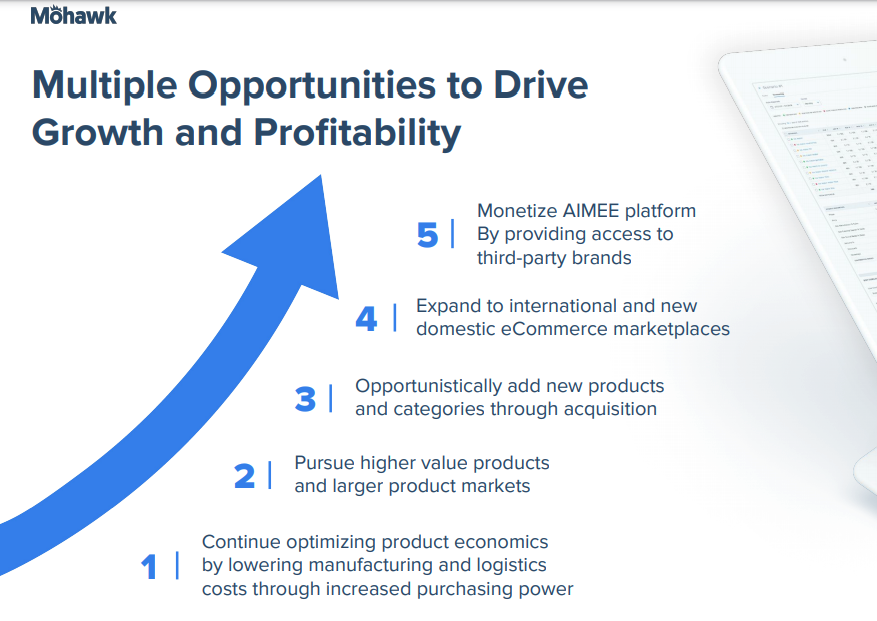
First, MWK has very rapid revenue growth - in the recent quarterly announcement, the revenue growth has accelerated from 43.6% in Q1 to 97% in Q2 from continued eCommerce tailwind. The company expected its net revenue in full year 2020 to be between $170 million to $180 million. That's an easy 49% increase compared to reported revenue $114 million in the prior year 2019. The analysts' estimate for MWK's revenue in 2021 is $214 million, which represents only 22.2% growth rate. This number seems underestimated given how early stage MWK is at in terms of the company's life cycle. It's not necessarily a bad thing to have an easier forecast target to beat, because it is always the surprise of beating/missing the expectation that moves the stock price. MWK still has so many levers to pull to further grow its business, such as launching more products in its main US market, expanding to international markets and monetizing its AI platform. The following presentation slide lists 5 different opportunities they have identified to drive their future growth; many of them are just starting, far from maturity.
Second, I'm very encouraged by its textbook example of economies of scale. MWK is not a profitable company yet, but in the recent quarter it has reported its first quarter with positive EBITDA. I took a closer look at its recent income statement - the fixed cost has barely grown from $27 million to $29 million when the revenue has almost doubled from $30 million to $59.8 million. 
This operating leverage will create a moat for MWK's business. As the revenue continues to grow, the percentage of operating expense in the total sales will become smaller and smaller, which will lead to eventual profitability. A company's stock price is ultimately determined by how much profit it earns. Profits are simply a function of two factors, sales and profit margin. So many companies dream to grow their earnings by growing their revenues or expanding their profit margins, but MWK seems to have both of them.


Insider holdings
Last but not least, I like to check the ownership of the management team to see whether their interest is aligned with all the other shareholders. It's reassuring to see the management team also has some skin in the game - when their personal net worth is directly tied to the stock performance of a company, they are more motivated to manage the company well and create values for the shareholders.

The table below shows the compensation the C-suite received in 2018 and 2019. Majority of the total compensation package came from option and stock awards. This is the compensation structure I generally prefer to see because the management team are not simply employees who are paid with a fixed salary. They own a share of the company they manage.

The details of the option awards also enhance my conviction in MWK. Most unvested option awards the management team holds have an expiration date in 2028 with an exercise price of $9.72. That's higher than the current price MWK is being traded at on the market. To prevent their option awards from expiring worthless, the management team has absolute incentives to increase the stock price to at least $9.72. This has provided enough margin of safety if the stocks are bought at current price level.


Conclusion
MWK has shown some very positive signs to be a multi-bagger super stock. I believe the company is still at a very early stage of its growth and it's currently at an inflection point to turn into a profitable business. With the presence of a relatively low risk entry point, I'm going to hold a sizable position until the investment pays off. 

July 26, 2020

USEG is speculative but ready to pop

Disclaimer: this is not the typical profitable company that attracts value investors. If you are looking for long-term quality businesses to hold forever, this is not for you. If you are into low float stocks with a turnaround potential, please continue to read.

U.S. Energy Corp. (USEG) is an independent energy company focused on the acquisition and development of oil and natural gas properties. A speculative play that has very low float with only 1.35M shares. 41.4% of the outstanding shares is held by the largest insider who paid $8.7/share in 2017. The stock was closed last Friday at $5.89. In addition, CEO holds 5%, and another trader, Guy Gentile, accumulated 9.79% in May 2020. 

The math is simple - the number of shares is already low to start with, and almost 60% is held by insiders who are not going to sell when they make a profit. Any small change in the sentiment or positive catalysts will pull the trigger.

Stats
  • share price: $5.89
  • average cost of the largest insider: $8.7
  • 1.35M shares outstanding after 1:10 reverse split in Jan 2020
  • only 540K shares (around 40%) are available to trade on the market
  • zero debt

Average cost of the largest insider
The largest insider, APEG II LP, didn't acquired its holdings through the open market; it takes a little effort digging into the historical filings. This is what I've found in the 13D form filed on 3/27/2019:
"The Shares beneficially owned by APEG II LP were the result of an exchange of loans held by APEG II LP and made to the Issuer, and these loans were financed with working capital through a creditor relationship whereby APEG II LP held $6,000,000 in principal amount of loans under the Credit Agreement dated as of July 30, 2010, as amended (the “Credit Facility”), as set forth in Item 6, comprising the entire principal balance outstanding under the Credit Facility (the “Balance”). APEG II LP then exchanged $5,063,380 of the Balance for 5,819,270 Shares on the terms and conditions set forth in the Exchange Agreement entered into on September 28, 2017, by and among the Issuer, Energy One LLC, and APEG II LP, as set forth in Item 6."

USEG had 1:10 reverse split in January 2020. The actual number of shares held by the APEG is now 581,727, which was exchanged from its debt balance $5,063,380 in 2017. It gives you $8.7/share.

Charts
1-year chart
5-year chart
10-year chart

The stock has formed a long quiet base since 2016 - it is unfavored and depressed. The price volatility has increased noticeably in the past week; I interpret this as an indicator that the liquidity is drying up. Think shares as a standardized commodity that can be traded on the market freely in real time. For anyone who knows economics 101, the price of the shares is determined by the basic law of demand and supply. When the supply is low (low float + insiders' shares not for sale), a small change in demand can push up the price easily. All it needs is a shift in the sentiment or a positive catalyst. More often than not, price can move higher without any significant news, especially when there are no more sellers left on the market. As small investors chase after price changes, an upward price movement can even become a catalyst itself.

The volume spike in the past week reveals an increasing interest in this stock. Many hands are exchanged to move the price up and down in big ways. All it needs is to wait for all the small sellers to sell out their positions - that's when the supply is close to 0 and a small demand will push up the price.

Fundamentals
As I said in the beginning, this is not a profitable business with an exciting story to tell. The net income has been negative for the past few years while still maintaining somewhat inconsistent free cash flow.

The good thing is that the business is at low risk of going out of business while waiting for the turnaround to take place given that it carries zero debt. At the same time, the largest shareholder, Patrick E. Duke, has been placed as a director on the board with an intention to change the business. This quote is from 13D file his company, APEG, filed:
"APEG II LP (together with its affiliates, “APEG”) continues to believe that the Issuer has the potential to be a strong company, but that substantial changes are needed, given the prolonged underperformance of the Issuer. Despite the past litigation between APEG and the Issuer, which is described further below in this Item 4, APEG hopes to dialogue constructively with the Issuer’s management team and board of directors (the “Board”) regarding opportunities to unlock value at the Issuer, including changes to the Board‘s composition. APEG believes that while it had no intention of making its concerns about the Issuer public, the Issuer‘s management and the Board’s actions have left it with no other alternative. In light of what APEG believes to be clear and continues shareholder value destruction, APEG has determined that it must act for the benefit of all shareholders to protect its investment in the Issuer."


I'll not bet a big position on this one, but I've put down a reasonably small position to wait and see. I like this classic Dhandho situation described by Mohnish Pabrai: Heads I win; Tails I don’t lose much. 

July 25, 2020

A free hydrogen fuel cell business within HY

Hyster-Yale Materials Handling (HY) is not a typical micro cap per se but is under-followed and unfavored by the market; yet it is one of my biggest positions so far. I noticed HY in 2018 when the insiders had some intense buying on the open market. The company has been going through a series of transformations since 2017, and the insiders have been increasing their positions in the past few years. This has aroused my interest to further investigate the reasons behind their move. I've been building up my position gradually with the insiders since last year. 

A few quick highlights about HY:
  • Market cap $635M with 16.7M shares
  • Insiders have increased their position from 18% to 24% in class A shares between 2017 and 2020
    • Insiders paid around $50 on the open market
  • $0 market valuation for Nuvera, the undiscovered hydrogen fuel cell division within HY (yes, it's given away for free)
    • 40% of net income from the other core business is offset by the loss from Nuvera
    • P/E is only 10.4 for the core business in lift truck if excluding Nuvera
    • Nuvera is anticipated to breakeven in near to medium term with the tailwind from China's clean energy market

HY is known as a full-line lift truck manufacturer that operates its business across the globe. The company has 3 main business divisions, namely, lift truck, Bolzoni and Nuvera, all of which are expected to see some growth in the medium term.

Nuvera - fuel cell business for free
Nuvera is a manufactuer of hydrogen fuel cell systems acquired by HY in late 2014. I was very excited to discover this "hidden asset" within the company, because Nuvera is often ignored by the investment community as the core business in lift truck has taken almost all the attention. However, after years of investments in R&D in hydrogen fuel cells, Nuvera is close to approaching its inflection point to turn breakeven and contribute substantially to the overall business.

No other fuel cell players are profitable; the overall fuel cell industry is experiencing years and years of losses. Unlike all the other fuel cell companies that finance their operations through external fundings via share issuance, Nuvera, however, is fully subsidized from the other profitable core business within HY. This kind of setup provides a sustainable source of funds into the emerging field that is yet to be profitable and prevents a dilution of existing shareholders's interest. The table from their annual presentation shows that over 40% of the net income from the core business is offset by Nuvera's loss.

Not every investment will turn out successful, but I don't believe HY invests so much money year after year on this unprofitable business if this is not going to yield any returns on its investment. Nuvera is among one of the first movers to launch fuel cell productions in China where huge government investment is focused on developing clean energy. Although the break-even target has been delayed due to additional testing and certification required by the local governments in China (breakeven was originally planned in 2H 2019). The production line has been completed in 2019 with shipments expected to ramp up throughout the second half of 2020; the results are expected to improve significantly in the next 3 years.

Because of the investments in the emerging fuel cell market, the company's overall net income is reduced deceivingly on the book. If Nuvera is taken out from the company, HY has $3.64 EPS and is evaluated at a P/E ratio around 10 given the current price of $37.8 (market cap $635M). Not a bad price to pay for a stable mature business with steadily growing revenue AND you get another fuel cell business for free!

To put things into perspective, if you look at the market valuation at other fuel cell players, BLDP, PLUG and FCEL have market cap at $3.85B, $2.76B, and $549M, respectively (none of them are profitable). Nuvera may not be as prominent as the other names, but this promising business with a clear breakeven prospect is still a steal at the valuation of $0. The fact that HY is under-followed by analysts may be the main reason behind the undervaluation. This is a good news for investors like me to obtain a share at a low price, when the market seems to have completely ignored the strategic position the company has built over the years quietly.

Core business that is also improving
The good news doesn't stop at Nuvera - the other two business lines are also expected to improve over time.

The main lift truck business is the foundation of the company. The management team is competent and has a track record of growing its revenue from $1.8B in 2010 to $3.2B in 2019. The current operating profit margin is only 2.8% and their objective is to achieve 7% target over the medium term with stronger industry and market share growth.

Bolzoni is a smaller business line that manufactures attachments and accessories for forklifts. Bolzoni has recently completed a restructuring to relocate its manufacturing from Homewood, IL to Sulligent, AL. The restructuring is expected to improve the operation in the following years and its operating profit is expected to increase this year with the absence of the $2.5M restructuring charges.

What are the risks
COVID-19 pandemic has negatively impacted the demand side of the lift truck business. Lots of uncertainty exists in the company's core lift truck business as bookings have been down due to the lockdown. The company has taken actions to reduce the operating cost such as reducing the base salaries for all the salaried employees. The near-term results from the core business will not look pretty and the recovery time could be slow depending on the market condition. 

The management has been conservative and the debt level has been low with high interest coverage ratio. The risk of going out of business is not my concern.

On the other hand, the outlook of fuel cell business still looks positive as China is stimulating to recover its economy with a focus on the new infrastructure and clean energy adoption. This tailwind has been confirmed by the recent new high of BLDP.  Here is recent news about a new order received by BLDP in China: https://ca.finance.yahoo.com/news/fuel-cell-stock-rallies-17-161313923.html 

Last but not least - chart
HY seems to have hit the support level and is being traded around the historically low market cap. The MA lines are still trending down, which reflects a general pessimistic sentiment on the stock. 

If you are looking for a quick rebound in the near term, this is not the right place to enter. However, if you are willing to build a position and wait a couple of years for the market to discover this company, now is a good time to acquire some shares at current prices.

The smart money is very patient and can wait years for a full fruition to come. If the insiders paid $50/shares, I'm happy to pay less than $40 now especially when the inflection point is around the corner.